
How to Use CER in Math: Claim, Evidence, Reasoning for Math Class
By Elizabeth Schroer, Founder of Reimagines · November 2026
If your students can get the right answer but freeze when a question says "explain your thinking," CER can help. Claim, evidence, reasoning gives students a simple three-part way to write about math, and it works from upper elementary all the way through high school.
Many teachers already know CER from science or ELA. It fits math just as well. Below, you'll find what each part means in a math classroom, sentence starters, two worked examples, and an easy way to teach it so students start using it on their own.
What is CER in math?
CER stands for claim, evidence, reasoning. It started as a way to help students write scientific explanations, and math teachers have adapted it so students can justify their answers. The Colorado Department of Education's math toolkit describes it this way: the claim is the solution, the evidence is the calculations, drawings, or diagrams used to find it, and the reasoning is the thinking (definitions and strategies) behind that work.
- Claim: What is the answer?
- Evidence: How did you do the math?
- Reasoning: Why does the math prove your answer?
Why CER works in math class
"Explain your answer" questions show up everywhere: open-ended problems, constructed-response test items, exit tickets, and class discussions. Students who understand the math often still struggle to put it into words. CER gives them a structure to follow, so the writing stops feeling like a guessing game.
- It makes thinking visible. You see how a student got the answer, which makes misconceptions much easier to spot.
- It supports the math practices. CER lines up naturally with constructing viable arguments and critiquing the reasoning of others, as this Edutopia article on CER in math explains.
- It builds math vocabulary. The reasoning step asks students to name the concept, property, or strategy they used.
- It connects subjects. When math, science, and ELA all use CER, students practice one way of explaining their thinking all day long.
The three parts of a math CER
Claim
What is the answer? Restate the question in a complete sentence and include the math context. What are you solving?
Evidence
How did you do the math? Explain with words, numbers, and symbols. Use step-by-step math concepts and vocabulary, and answer multiple parts separately.
Reasoning
Why does the math prove your answer? Connect the evidence to the claim using math vocabulary.
Evidence or reasoning? This is the part students mix up most. Evidence is the work: the steps, numbers, and model. Reasoning is the why: the rule, property, or idea that makes the work correct. If a student's reasoning just repeats their steps, ask, "What math idea makes that step true?"
CER math sentence starters
Sentence starters give every student a way to begin, especially English learners and students who freeze at a blank page. These are the same starters printed on our Math CER sentence starter clings.
Claim
- I claim that...
- The answer is... because...
- ... is the correct solution.
Evidence
- I solved this by...
- The steps I used were: first... next... and finally...
- Using the formula... I found...
Reasoning
- My answer is correct because...
- The answer makes sense because...
- This shows that...
CER math examples
Here are two CER math examples you can model with your class. Notice that the claim answers the question in a full sentence, the evidence shows the work, and the reasoning names the math idea.
Upper elementary: comparing fractions
Jada ate 3/4 of her sandwich. Leo ate 5/8 of his. The sandwiches are the same size. Who ate more?
ClaimI claim that Jada ate more of her sandwich than Leo did.
EvidenceI solved this by finding a common denominator. 3/4 is equal to 6/8, because 3 x 2 = 6 and 4 x 2 = 8. Then I compared 6/8 and 5/8. Six eighths is more than five eighths.
ReasoningMy answer is correct because when two fractions have the same denominator, the pieces are the same size, so the fraction with more pieces is larger. Multiplying the numerator and denominator by the same number makes an equivalent fraction, so 3/4 and 6/8 are the same amount.
Middle school: unit rate
A 12-pack of pencils costs $3.00. A 30-pack costs $6.60. Which is the better buy?
ClaimThe 30-pack of pencils is the better buy.
EvidenceI found the unit price of each pack. For the 12-pack, $3.00 ÷ 12 = $0.25 per pencil. For the 30-pack, $6.60 ÷ 30 = $0.22 per pencil. $0.22 is less than $0.25.
ReasoningThis shows that the 30-pack costs less for each pencil. A unit rate tells the cost of one item, so comparing unit rates lets me compare packs of different sizes fairly. The lower unit price is the better buy.
For high school, try a claim that has to hold every time, such as "The sum of two odd numbers is always even." Examples make good evidence, and the reasoning can use algebra to show why it always works.
How to teach CER in math
- Model one out loud. Solve a problem in front of the class and write the claim, evidence, and reasoning as you talk through each choice.
- Start with the claim. For the first week, have students write just a complete-sentence claim. It's a quick win and it builds the habit of restating the question.
- Use a problem of the day. One short CER a day is better than one long one a week. Write the class response right next to your anchor chart.
- Practice one part at a time. Give students a finished claim and evidence and ask only for the reasoning. Reasoning takes the most practice.
- Let students critique each other. Partners trade responses and check: Does the claim answer the question? Does the evidence show the work? Does the reasoning explain why?
- Keep it visible. Students use a framework on their own when they can see it. Point to each section as you teach, and fade the sentence starters as students get comfortable.
Keep CER on your whiteboard
Paper anchor charts take time to make, and they tear, curl, or get covered up. So we made a CER anchor chart for math that lives right on your whiteboard.
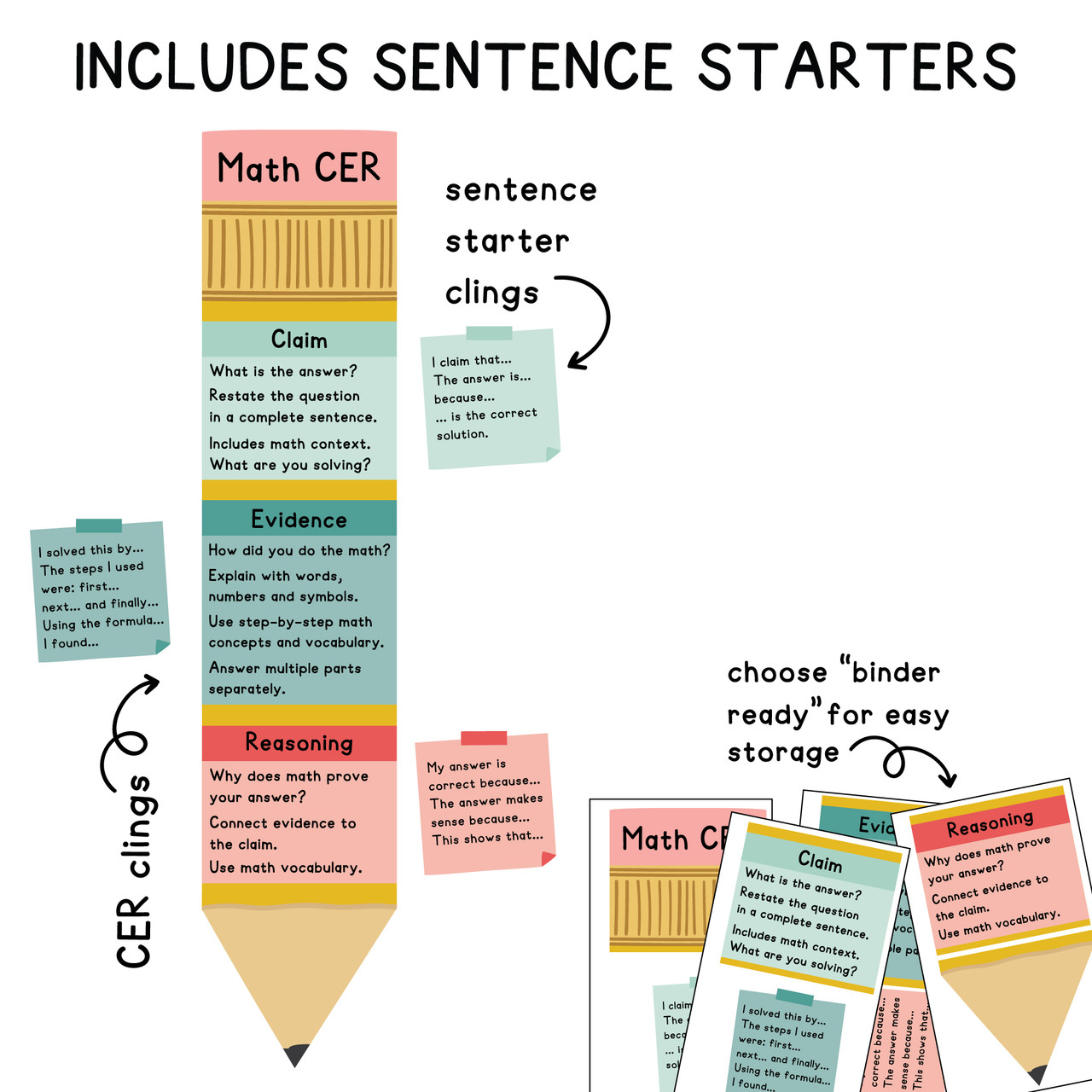
Our CER Math Framework Clings are a pencil-shaped anchor chart with a Math CER header and the claim, evidence, and reasoning prompts above. The pencil is 13.2" tall and 7.3" wide, so it fits along the side of your board and leaves room for the problem of the day. Three sentence starter note clings (5.3" square) go right beside it.
- Not a sticker. It's a durable, flexible static cling that holds to a clean whiteboard with no adhesive and no residue.
- Works on non-magnetic whiteboards, plus glass, windows, and acrylic.
- Reusable. Leave it up all year, or store it on Binder Ready sheets until your next unit.
- Ready the day it arrives. No designing, printing, laminating, or cutting. Designed and printed in-house by our family and shipped within two business days.
Two ways to order: the Reimagines Ready set comes in one ready-made look with the sentence starters included. Or choose your colorway, font, and text color, and add the sentence starters if you'd like them.
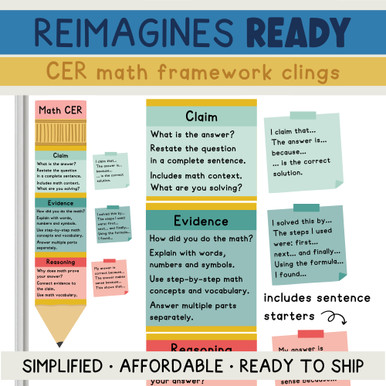 Reimagines Ready CER Math Framework Clings (sentence starters included)
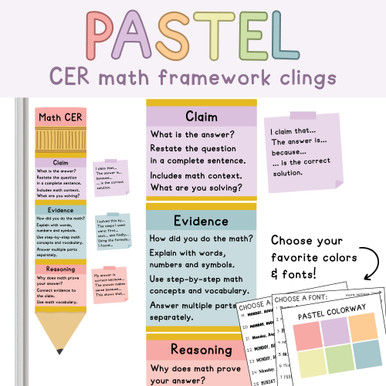 Pastel CER Math Framework Clings
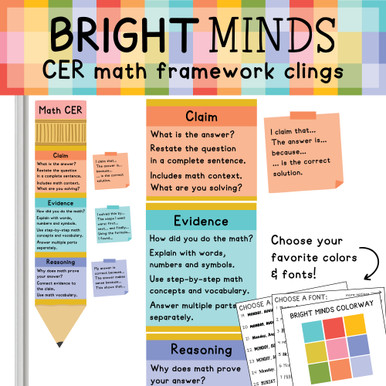 Bright Minds CER Math Framework Clings
All colorways: Blue and Green · Bright Minds · Earth Tones · Happy Camper · Modern Terrazzo · Pastel · Pink and Purple · Rainbow · Retro Brights · Tropical Botanical · Varsity Stripes
Using CER in other subjects?
Give students the same framework all day with our CER Science Framework Clings and ELA CER Framework Clings. For word problems, the CUBES Math Strategy Clings help students solve the problem before they explain it with CER.
FAQ
What does CER stand for in math?
CER stands for claim, evidence, reasoning. The claim is the answer, the evidence is the work that shows how you got it, and the reasoning explains why the math proves the answer is correct.
What is the difference between evidence and reasoning in math?
Evidence is the work: calculations, steps, drawings, graphs, or tables. Reasoning is the math idea that makes the work correct, such as a property, definition, formula, or strategy, and how it connects back to the claim.
What grades can use CER in math?
CER works from upper elementary through high school. Younger students can focus on a complete-sentence claim and showing their work, while older students write fuller reasoning using properties, theorems, and algebra.
Can I use CER for word problems and test prep?
Yes. CER is a natural fit for open-ended problems, constructed-response questions, and any prompt that asks students to explain or justify their answer.
Is the Math CER anchor chart a sticker?
No. It's a static cling, so it holds to a clean whiteboard without adhesive and comes off with no residue. You can move it, store it, and reuse it year after year. Don't write on the clings, since markers can remove the ink. Write under or next to them instead.
Will it stick to my whiteboard?
Static cling holds best to a clean, dust-free board. Dust, oil, and greasy cleaners interfere with the grip, so wipe your board with vinegar and water first. It was originally designed for non-magnetic whiteboards and also clings to glass, windows, and acrylic.
Can I get custom colors or a custom design?
Yes. Choose from 11 colorways with font and text color options, or email elizabeth@reimagines.com for custom designs and color matching.
No printing, cutting or laminating! Just peel, cling and teach.
Put claim, evidence, and reasoning where every student can see it.
Shop CER Math Clings