
What Is CHAMPS? A Teacher's Guide to CHAMPS Classroom Management
By Elizabeth Schroer, Founder of Reimagines · November 2026
CHAMPS is a classroom management approach that tells students exactly what's expected during each activity. The letters stand for Conversation, Help, Activity, Movement, Participation, and Success.
Instead of repeating "Can we talk?" and "Can I get up?" all day, you set the expectations once, post them where everyone can see, and point to them. Below you'll find what each letter means, CHAMPS voice levels, ready-to-use examples for common activities, and tips for teaching it in elementary, middle, and high school.
What is CHAMPS?
CHAMPS is a proactive, positive approach to classroom management developed by Randy Sprick and his colleagues at Safe & Civil Schools. Their book, CHAMPS: A Proactive and Positive Approach to Classroom Management, focuses on clear expectations, consistent routines, and frequent positive feedback.
The acronym is the part most teachers see on the wall. As the Institute of Education Sciences describes it, teachers use Conversation, Help, Activity, Movement, Participation, and Success as a guide to define behavior expectations for each type of activity. The expectations change from activity to activity, so students always know what "doing it right" looks like right now.
- Conversation: Can I talk? How loud?
- Help: How do I get help?
- Activity: What are we doing?
- Movement: Can I get up and move?
- Participation: What does being engaged look like?
- Success: What happens when we meet every expectation?
What each letter of CHAMPS means
Conversation
How loud should students be? Use voice levels, from silence to presenter voice.
Help
What should students do when they need help? Raise your hand, ask a friend, or try your best.
Activity
What are students doing? Whole group lesson, independent work, or partner or group work.
Movement
Can students move around? Stay in your seat, work with a partner, or free movement.
Participation
What does engagement look like? Listen to the speaker, turn and talk, or work independently.
Success
The goal. What students achieve when every expectation is met.
Make the choices your own. The options above are a starting point. Movement might include "sharpen pencils only before the bell," and Help might include "check the board, then ask three before me." What matters is that students know the answer to each question before the activity starts.
CHAMPS voice levels
Conversation is usually shown with voice levels. A four-level scale is easy for students to remember and covers almost every activity in a school day.
| Level | Sounds like | Use it for |
|---|---|---|
| Level 0 | Silence | Tests, independent reading, fire drills |
| Level 1 | Whisper | Independent work with quiet questions, the library |
| Level 2 | Partner voice | Turn and talk, partner work, small groups |
| Level 3 | Presenter voice | Sharing with the class, presentations, answering a question |
Practice each level out loud in the first week. Let students hear what a Level 1 whisper sounds like compared to a Level 2 partner voice, so there's no guessing later.
CHAMPS examples for common activities
Here's how CHAMPS might look for five activities most classrooms use every day. Set your board before the activity, review it in under a minute, and start.
Whole group lesson
C: Level 0, or Level 3 when called on
H: Raise your hand
A: Whole group lesson
M: Stay in your seat
P: Listen to the speaker
Independent work
C: Level 0 or Level 1
H: Try your best, then raise your hand
A: Independent work
M: Stay in your seat
P: Work independently
Partner or group work
C: Level 2
H: Ask a friend, then raise your hand
A: Partner or group work
M: Work with a partner
P: Turn and talk
Transitions
C: Level 0 or Level 1
H: Wait until you're in your new spot
A: Transitions
M: Free movement, walking feet
P: Follow the directions on the board
Test or quiz
C: Level 0
H: Raise your hand
A: Test or quiz
M: Stay in your seat
P: Work independently
When every expectation is met, that's Success. Many teachers tie it to a class reward, like a marble in the jar or a few minutes of free choice at the end of the week.
How to teach CHAMPS
- Teach it like a lesson. In the first weeks, introduce one letter at a time and talk through why each expectation matters.
- Model and practice. Show what each voice level and movement choice looks like, then have students practice. Role-play a "wrong" example so they can spot the difference.
- Review before every activity. Take 30 seconds to walk through the board: "We're at Level 1, raise your hand for help, stay in your seat."
- Point instead of repeat. When someone forgets, point to the letter. It's calmer than repeating directions, and it puts the responsibility back on the student.
- Notice the positive. Name what students are doing right: "Table three is at a perfect partner voice." Positive feedback is a big part of the CHAMPS approach.
- Reset after breaks. Reteach expectations after winter break, spring break, and testing season, when routines tend to slip.
CHAMPS in middle and high school
CHAMPS isn't just for little kids. Older students appreciate knowing the rules up front, especially when they move between six or seven teachers with different expectations. The original materials were written for K-8, with a companion book for high school, and the same idea works at every grade.
- Keep the wording grown-up. "Presenter voice" and "collaborate with your group" work better than cartoon icons.
- Add phones and laptops. Use Help or Participation to say when devices are allowed and what they're for.
- Agree as a team. If a grade level or department uses the same CHAMPS language, students carry it from class to class.
Common CHAMPS mistakes
- Posting it and never pointing to it. CHAMPS works when it's part of every activity, not just decoration.
- Not changing it. If the board says "Level 0" during partner work, students learn to ignore it. Update it every time the activity changes.
- Too many options. Three or four choices per letter is plenty. Keep it simple enough for students to read at a glance.
- Skipping Success. Celebrate when the class meets every expectation. That's what makes students want to do it again.
Keep CHAMPS on your whiteboard
The easiest CHAMPS chart to use is the one you can change in seconds. Paper charts tear and curl, and rewriting expectations by hand takes time you don't have between classes. So we made a CHAMPS display that lives right on your whiteboard.
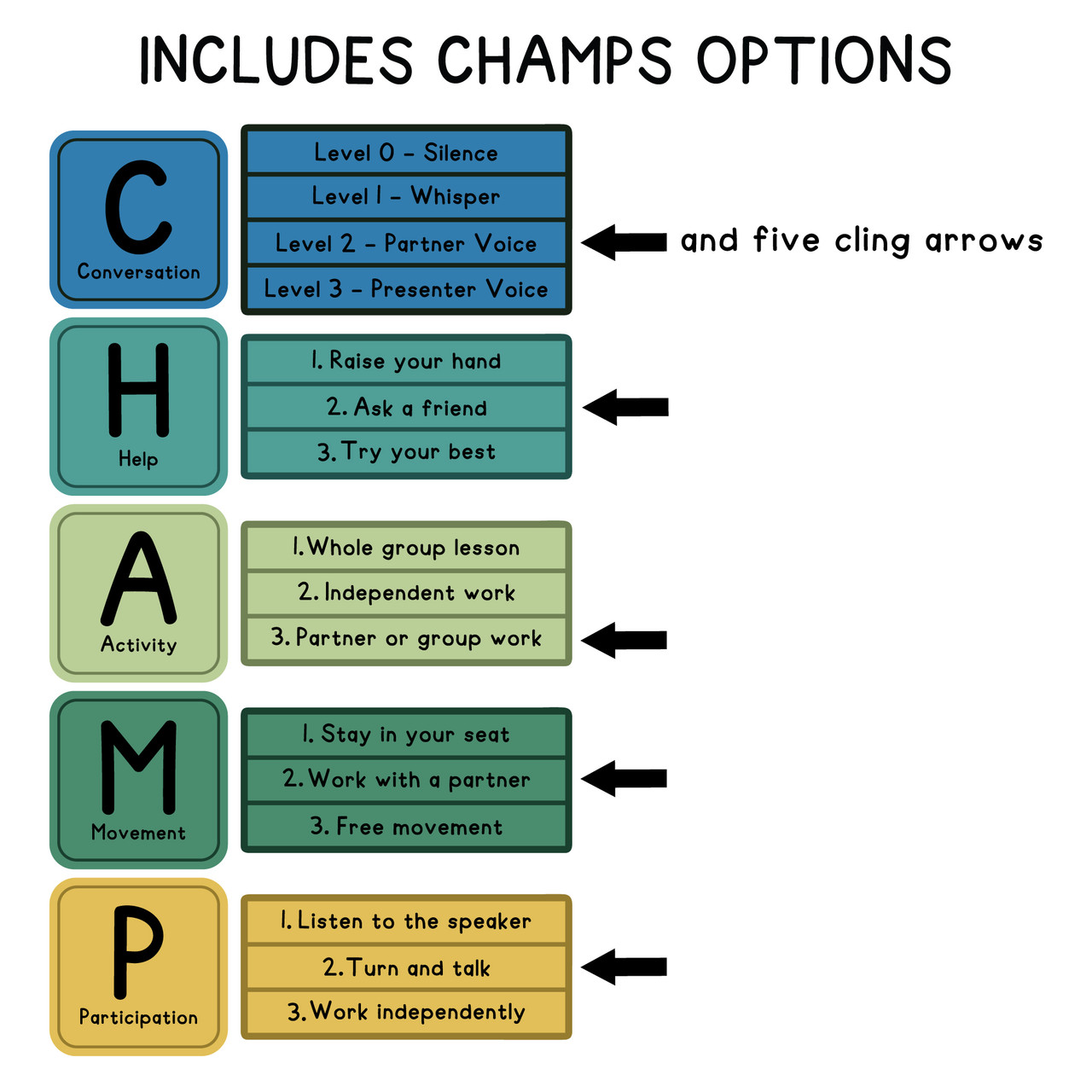
Our CHAMPS Classroom Management Clings include six 4.5" letter clings in square or round style, option clings with three or four choices for each letter, and five movable arrows. Slide an arrow to switch from a whole group lesson to partner work, and you're done.
- Not a sticker. It's a durable, flexible static cling that holds to a clean whiteboard with no adhesive and no residue.
- Works on non-magnetic whiteboards, plus glass, windows, and acrylic.
- Your wording. On our colorway sets, choose our standard options or type your own choices at checkout, up to four per letter.
- Ready the day it arrives. No designing, printing, laminating, or cutting. Designed and printed in-house by our family and shipped within two business days.
Two ways to order: the Reimagines Ready set comes in one ready-made look with the option clings and arrows included. Or choose your colorway, font, and text color, and add the option clings and arrows if you'd like them.
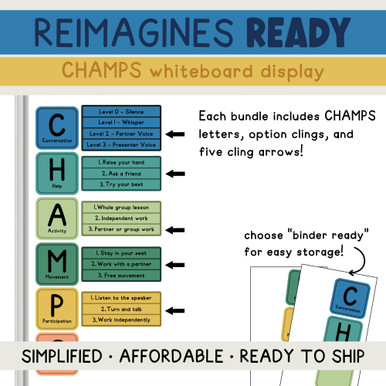 Reimagines Ready CHAMPS Classroom Management Clings (options and arrows included)
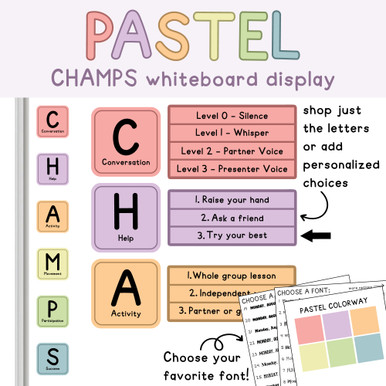 Pastel CHAMPS Classroom Management Clings
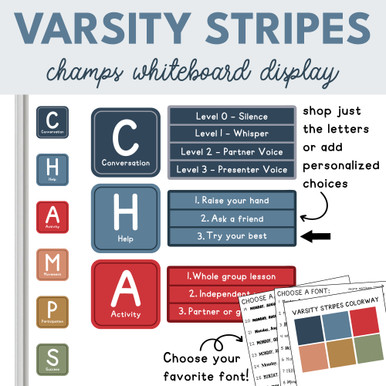 Varsity Stripes CHAMPS Classroom Management Clings
All colorways: Blue and Green · Bright Minds · Earth Tones · Happy Camper · Modern Terrazzo · Pastel · Pink and Purple · Rainbow · Retro Brights · Tropical Botanical · Varsity Stripes
More teaching guides
Once your routines are set, try the RACES writing strategy for written responses, or see all of our free teaching guides.
FAQ
What does CHAMPS stand for?
CHAMPS stands for Conversation, Help, Activity, Movement, Participation, and Success. Each letter answers a question students have about how to behave during an activity.
Who created CHAMPS?
CHAMPS was developed by Randy Sprick and colleagues at Safe & Civil Schools as part of a proactive, positive approach to classroom management.
What are CHAMPS voice levels?
Most classrooms use four levels: Level 0 is silence, Level 1 is a whisper, Level 2 is a partner voice, and Level 3 is a presenter voice for sharing with the whole class.
Does CHAMPS work in high school?
Yes. Older students benefit from knowing expectations up front, especially when they switch between several teachers. Use grown-up wording and include expectations for phones and laptops.
How often should I change my CHAMPS chart?
Every time the activity changes. If the expectations for partner work are different from a whole group lesson, update the chart before you start so it always matches what students are doing.
Is the CHAMPS display a sticker?
No. It's a static cling, so it holds to a clean whiteboard without adhesive and comes off with no residue. Move the arrows as often as you like. Don't write on the clings, since markers can remove the ink.
Will it stick to my whiteboard?
Static cling holds best to a clean, dust-free board. Dust, oil, and greasy cleaners interfere with the grip, so wipe your board with vinegar and water first. If a cling loses its grip, rinse the back with water. It was originally designed for non-magnetic whiteboards and also clings to glass, windows, and acrylic.
Can I get custom colors or my own wording?
Yes. Choose from 11 colorways with font and text color options, and type your own choices for any letter at checkout. For custom designs and color matching, email elizabeth@reimagines.com.
No printing, cutting or laminating! Just peel, cling and teach.
Set clear expectations before every activity, and change them in seconds.
Shop CHAMPS Clings