
The RACES Writing Strategy: Steps, Examples, and Sentence Starters
By Elizabeth Schroer, Founder of Reimagines · November 2026
RACES is a five-step strategy for writing a complete answer to a short-response question: Restate the question, Answer it, Cite evidence, Explain the evidence, and Summarize. It turns "I don't know what to write" into a checklist students can follow.
If your students answer reading questions with one sentence, or skip the evidence altogether, RACES gives them a clear path from the question to a finished paragraph. Below you'll find what each step means, sentence starters, two complete RACES examples, the difference between RACE and RACES, common mistakes, and tips for teaching it in any subject.
What is the RACES writing strategy?
RACES is an acronym that helps students write organized, text-based answers to open-ended questions, often called constructed responses. Each letter is one job the answer needs to do. Purdue University's K-12 outreach describes it the same way: restate the prompt, give a clear answer, support it with evidence, explain how that evidence supports it, and wrap up with a summary.
Teachers like RACES because it works on reading passages, short-answer test questions, and written responses in science and social studies too. Once students know the five steps, they can check their own answers before turning them in.
- Restate the question
- Answer the question
- Cite the evidence
- Explain your answer
- Summarize your ideas
The five steps of RACES
Restate
Restate the question. Turn the question into a statement.
Answer
Answer the question. Answer all parts of the question in complete sentences.
Cite
Cite the evidence. Use details and facts from the text to support your answer.
Explain
Explain your answer. Explain how the evidence supports your answer.
Summarize
Summarize your ideas. Restate the question and summarize your answer with a conclusion.
Restate and answer can share a sentence. Many students write "Reading is important because it builds vocabulary" as one sentence that does both jobs. That's fine. What matters is that every part of the question gets answered.
RACES sentence starters
Sentence starters give every student a way in, especially English learners and students who freeze at a blank page. Post them next to the letters and take them down as students get comfortable.
| Step | Sentence starters |
|---|---|
| Restate | Use the question's own words to begin. · The reason... is... · In the story,... |
| Answer | ...because... · I think... · The main reason is... |
| Cite | The text states... · According to the text... · On page ___, the author says... · For example,... |
| Explain | This means... · This shows that... · This proves... because... |
| Summarize | In conclusion,... · As you can see,... · For these reasons,... · Overall,... |
RACES examples
Here's the example printed on our RACES speech bubble clings, followed by two more you can model with your class. Each step is labeled so students can see how the pieces fit together.
The example on our clings
Why is reading important?
RestateReading is important because...
AnswerReading is important because it improves vocabulary and writing skills.
CiteThe text states that exposure to different words and writing styles builds vocabulary.
ExplainThis means students will improve their writing and speaking skills by reading different books.
SummarizeReading is one of the best things kids can do to enhance their learning.
Upper elementary: informational text
How do honeybees survive cold winters?
RestateAnswerHoneybees survive cold winters by working together to stay warm.
CiteThe text states that the bees "form a tight ball inside the hive" and "shiver their wing muscles to make heat." It also says they "take turns moving from the cold outside of the ball to the warm center."
ExplainThis shows that no single bee could stay warm alone. By huddling, making heat, and trading places, the whole colony shares the warmth so every bee gets a turn in the center.
SummarizeIn conclusion, honeybees make it through the winter because they work as a team.
Middle school: literature
What trait does Marcus show in this passage? Use evidence from the text to support your answer.
RestateAnswerIn this passage, Marcus shows that he is determined, because he keeps going after his plan falls apart.
CiteWhen his note cards fall, he "took a breath, left the cards where they fell," and told the class, "I'll just tell you what I know."
ExplainMost people would stop or scramble to pick the cards up. Marcus chooses to keep speaking without them, which proves he cares more about finishing than about doing it perfectly. The class leaning in shows his choice worked.
SummarizeAs you can see, Marcus is determined because he finds a way to finish his speech even when things go wrong.
For high school, raise the bar on Cite and Explain. Ask for two pieces of evidence, and have students explain how each one supports the answer instead of summarizing the quote.
RACE vs. RACES
RACE and RACES are the same strategy. RACE has four steps: restate, answer, cite, and explain. RACES adds a fifth step, summarize, which gives the paragraph a closing sentence. Some teachers start with RACE for shorter answers and add the S once students are ready for longer responses. If your school or state test calls for a concluding sentence, teach RACES from the start.
You'll also see variations like RACER (Restate, Answer, Cite, Explain, Review) or RACES where the E stands for "explain and extend." The steps are close enough that students can switch between them, so use whichever version your team agrees on and keep it consistent across classes.
Common RACES mistakes
- Answering only part of the question. Have students underline every question word and check off each part as they answer it.
- Citing without the text. Evidence has to come from the passage, not from memory or opinion. "According to the text" is a good reminder.
- Explaining by repeating the quote. If the Explain sentence just restates the evidence, ask, "So what does that prove?"
- Making it too robotic. RACES is five jobs, not five fill-in-the-blank sentences. Once students know the steps, encourage them to combine and vary their sentences.
- Forgetting the summary. A one-sentence wrap-up that ties back to the question is enough.
How to teach RACES
- Introduce one letter at a time. Spend a day or two on restating questions before adding the next step. Restating is a quick win most students can master fast.
- Model it out loud. Write a full response in front of the class and talk through each choice, especially how you picked your evidence.
- Color-code it. Give each step a color and have students highlight their own paragraphs. A missing color shows right away which step they skipped.
- Write it together. Build a class response on the board, one step at a time, right next to each letter.
- Sort it. Cut a finished response into sentences and have partners put them back in RACES order.
- Use it all year. Short practice with the same steps in reading, science, and social studies builds the habit faster than a single writing unit.
RACES in every subject
RACES isn't just for ELA. Any question that asks students to explain their thinking with evidence is a RACES question.
- Social studies: "Why did the colonists protest the Stamp Act?" Students cite a primary source or the textbook.
- Science: "What does the graph show about plant growth and sunlight?" Students cite data from the graph. For lab conclusions, many science teachers use CER instead. See our guide to CER in science.
- Math: "Which store has the better deal? Explain." Students cite their calculations. Our CER in math guide has more ideas for written math responses.
Keep RACES on your whiteboard
Paper anchor charts take time to make, and they tear, curl, or get covered up halfway through the year. So we made a RACES anchor chart that lives right on your whiteboard.
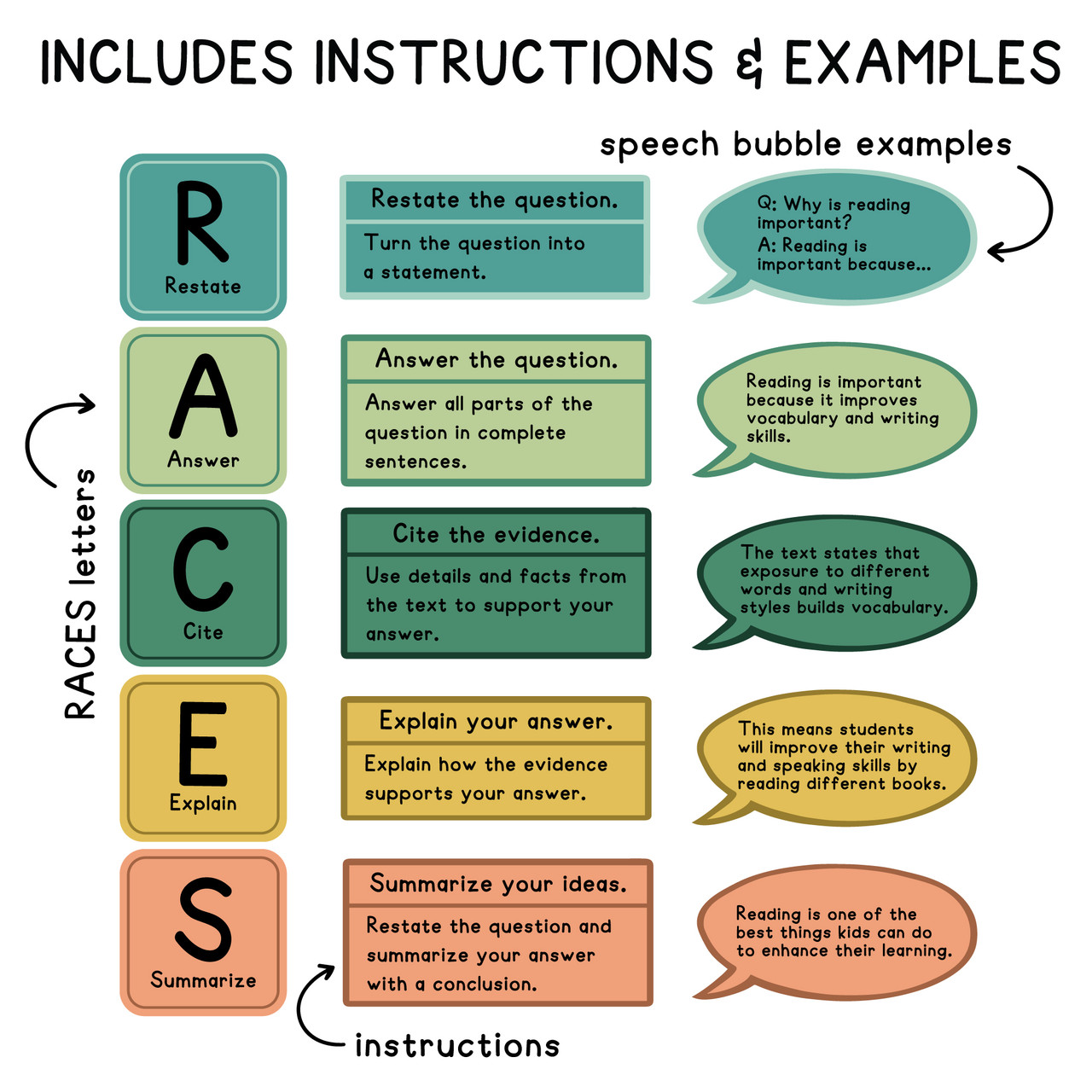
Our RACES Classroom Writing Clings include five 4.5" letter clings in square or round style, each with its action word. Add the five instruction clings (just over 8" wide) that spell out each step, and the five speech bubble examples (about 8" x 4") that model a complete answer.
- Not a sticker. It's a durable, flexible static cling that holds to a clean whiteboard with no adhesive and no residue.
- Works on non-magnetic whiteboards, plus glass, windows, and acrylic.
- Reusable. Leave it up all year, or store it on Binder Ready sheets between units.
- Ready the day it arrives. No designing, printing, laminating, or cutting. Designed and printed in-house by our family and shipped within two business days.
Two ways to order: the Reimagines Ready set comes in one ready-made look with the instructions and speech bubble examples included. Or choose your colorway, font, and text color, and add the instructions and examples if you'd like them.
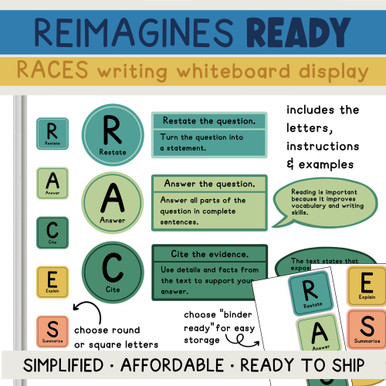 Reimagines Ready RACES Classroom Writing Clings (instructions and examples included)
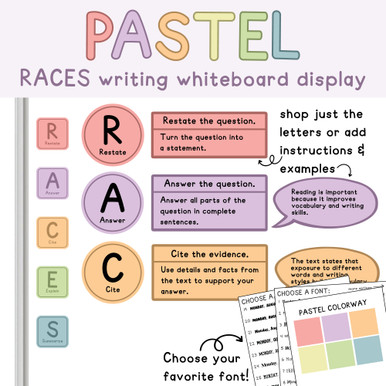 Pastel RACES Classroom Writing Clings
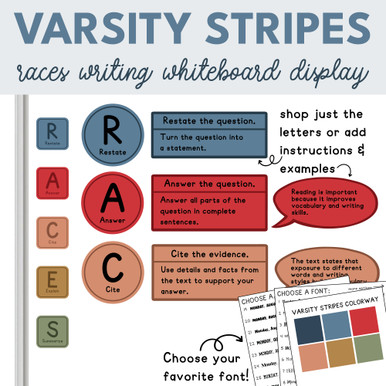 Varsity Stripes RACES Classroom Writing Clings
All colorways: Blue and Green · Bright Minds · Earth Tones · Happy Camper · Modern Terrazzo · Pastel · Pink and Purple · Rainbow · Retro Brights · Tropical Botanical · Varsity Stripes
Pairs well with
For argument writing, the ELA CER Framework Clings give students a claim, evidence, reasoning structure. For longer projects, the Writing Process Pencil Clings walk them from brainstorm to publish.
FAQ
What does RACES stand for?
RACES stands for Restate, Answer, Cite, Explain, and Summarize. It's a five-step strategy for writing a complete, text-based answer to an open-ended question.
What is the difference between RACE and RACES?
RACE has four steps: restate, answer, cite, and explain. RACES adds a fifth step, summarize, which gives the response a concluding sentence.
What grade levels use RACES?
RACES is most common from third grade through high school. Younger students focus on restating and answering with one piece of evidence. Older students cite multiple pieces of evidence and write fuller explanations.
Is RACES the same as CER?
They're close cousins. Both ask students to answer, give evidence, and explain it. RACES is built for answering a specific question about a text, while CER (claim, evidence, reasoning) is often used for scientific explanations and arguments.
Is the RACES anchor chart a sticker?
No. It's a static cling, so it holds to a clean whiteboard without adhesive and comes off with no residue. You can move it, store it, and reuse it year after year. Don't write on the clings, since markers can remove the ink. Write under or next to them instead.
Will it stick to my whiteboard?
Static cling holds best to a clean, dust-free board. Dust, oil, and greasy cleaners interfere with the grip, so wipe your board with vinegar and water first. If a cling loses its grip, rinse the back with water. It was originally designed for non-magnetic whiteboards and also clings to glass, windows, and acrylic.
Can I get custom colors or a custom design?
Yes. Choose from 11 colorways with font and text color options, or email elizabeth@reimagines.com for custom designs and color matching.
No printing, cutting or laminating! Just peel, cling and teach.
Put all five RACES steps where every student can see them.
Shop RACES Clings