
What Is CER in Science? Claim, Evidence, Reasoning Explained
By Elizabeth Schroer, Founder of Reimagines · November 2026
CER stands for claim, evidence, reasoning. It's a three-part way for students to write a scientific explanation: answer the question, back it up with data, and explain the science that connects the two.
If your students can run a great lab but their conclusions come out as "it worked," CER gives them a structure to follow. Below you'll find what each part means, sentence starters, two CER science examples, a simple color-coding routine, and tips for teaching it from upper elementary through high school.
What is CER in science?
CER is a framework for writing scientific explanations. Researchers Katherine McNeill and Joseph Krajcik developed it with middle school science teachers. It breaks an explanation into three parts: a claim that answers the question, evidence from scientific data, and reasoning that shows why the data counts as evidence.
CER also supports the science practice of engaging in argument from evidence in the Next Generation Science Standards. That's why so many science departments use it for lab conclusions, science notebooks, and constructed-response questions.
- Claim: What do you think?
- Evidence: What did you find?
- Reasoning: Why does it matter?
The three parts of a CER
Claim
What do you think? Answer the question in a clear, one-sentence statement.
Evidence
What did you find? Use information from experiments, data, observations, and text to support your claim.
Reasoning
Why does it matter? The rule or scientific principle that explains why and how the evidence supports the claim.
Evidence or reasoning? Evidence is what you observed or measured. Reasoning is the science idea that explains it. If a student's reasoning just repeats their data, ask, "What science concept explains why that happened?"
CER sentence starters for science
Sentence starters help every student begin, especially English learners and students who stall at a blank page. These are the same starters printed on our CER Science speech bubble clings.
Claim
- I claim that...
- The answer is...
- Based on the investigation...
Evidence
- According to the data...
- The investigation showed...
- The text states...
Reasoning
- This supports my claim...
- This evidence shows...
- The scientific principle is...
CER science examples
Here are two CER examples you can model with your class. The claim answers the question in one sentence, the evidence uses specific numbers, and the reasoning names the science idea.
Upper elementary: insulators
Which material keeps an ice cube frozen the longest: a wool sock, a paper towel, or nothing at all?
ClaimI claim that the wool sock keeps an ice cube frozen the longest.
EvidenceAccording to the data, the ice cube wrapped in the wool sock took 62 minutes to melt. The ice cube in the paper towel took 44 minutes, and the ice cube with no wrapping took 35 minutes.
ReasoningThis evidence shows that wool is the best insulator of the three. Heat moves from warmer things to colder things, so heat from the warm room moves into the ice. An insulator slows that heat transfer, so the ice cube wrapped in the wool sock stayed frozen the longest.
Middle school: chemical reactions
When baking soda and vinegar are mixed, is it a physical change or a chemical change?
ClaimMixing baking soda and vinegar causes a chemical change.
EvidenceThe investigation showed that bubbles formed right away and the mixture fizzed for about 30 seconds. The temperature of the mixture dropped from 22°C to 16°C.
ReasoningThe scientific principle is that a chemical change makes new substances. Gas being produced and an unexpected temperature change are two signs of a chemical reaction. The bubbles are a new gas, carbon dioxide, that was not there before, so this is a chemical change.
For high school, raise the bar on evidence. Ask students to use multiple trials, an average, or a graph, and to explain any data that doesn't fit.
What a strong CER looks like
McNeill and Krajcik describe good evidence as appropriate and sufficient: it fits the question, and there's enough of it to convince someone else. They also found that the claim is the easiest part for students to write. Use this quick checklist before students turn in a CER:
- Claim: Does it answer the question in one clear sentence?
- Evidence: Does it use specific data, with numbers and units where possible? Is there more than one piece?
- Reasoning: Does it name a science concept, rule, or principle? Does it explain how that idea connects the evidence to the claim?
Color-coding CER
Color-coding is one of the easiest ways to help students see the three parts of their own writing. Give each part one color, and keep the same colors everywhere: on your anchor chart, in graphic organizers, and on student highlighters.
- Highlight it. After writing, students highlight their claim, evidence, and reasoning in the matching colors. A missing color shows right away which part needs work.
- Match the board. On our Reimagines Ready set, claim is orange, evidence is teal, and reasoning is green, so students can check their colors against the anchor chart.
- Sort it. Cut a sample CER into sentences and have partners sort them into claim, evidence, and reasoning before they write their own.
How to teach CER in science
- Start with a phenomenon. A quick demo or video with a clear question gives students something real to make a claim about.
- Model one out loud. Write a full CER in front of the class and talk through each choice, especially why your reasoning names a science idea.
- Write the claim first. Early on, have students write only a one-sentence claim. It's a quick win and builds the habit of answering the question.
- Practice one part at a time. Give students a claim and evidence and ask only for the reasoning. Reasoning takes the most practice.
- Use it after every lab. A short CER is a natural lab conclusion, so students practice it all year, not just during one unit.
- Keep it visible and fade the support. Point to each part as you teach. As students get comfortable, take down the sentence starters and leave the framework up.
Keep CER on your whiteboard
Paper anchor charts take time to make, and they tear, curl, or get covered up by the end of the first unit. So we made a CER anchor chart that lives right on your whiteboard.
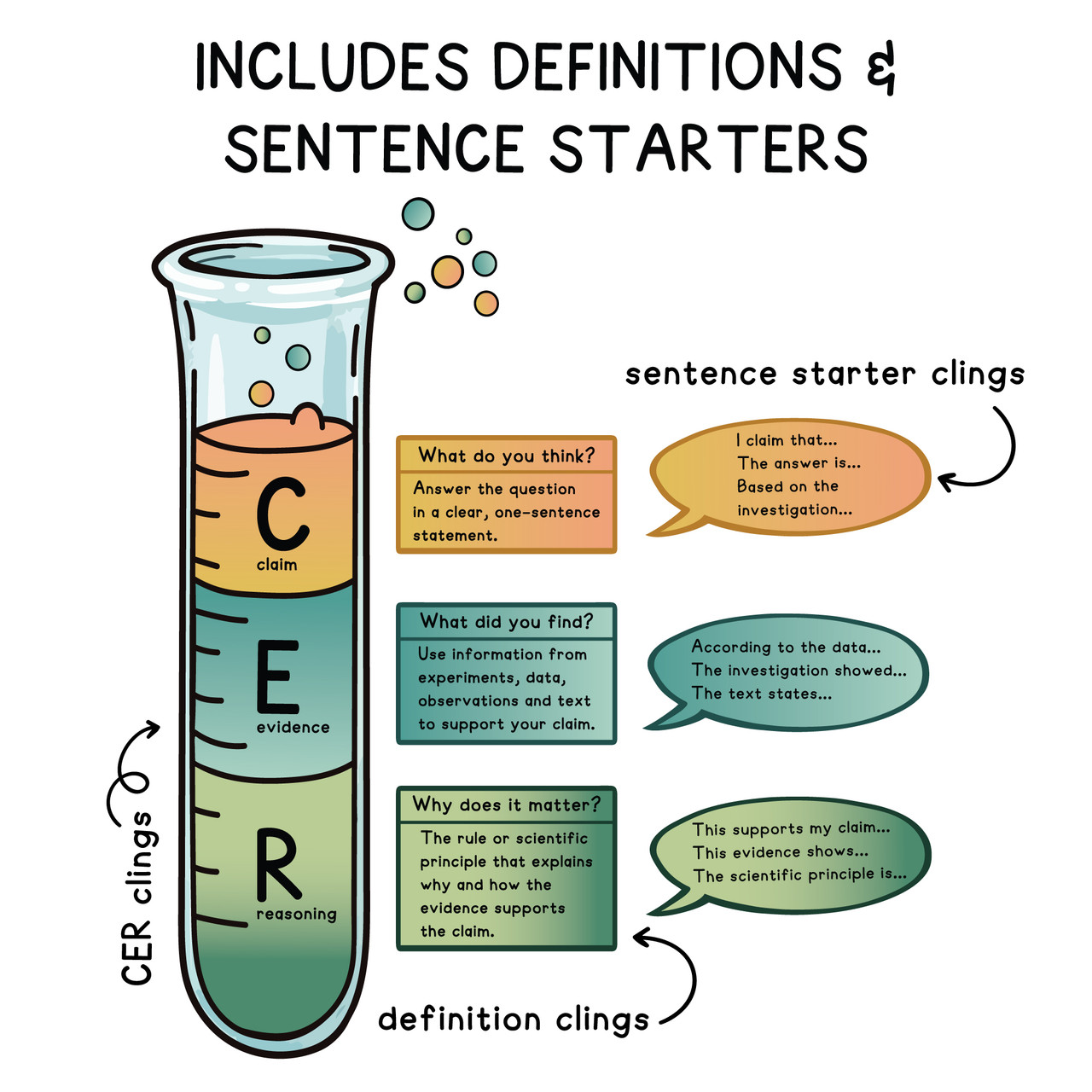
Our CER Science Framework Clings are a test tube anchor chart with C, E, and R sections. The test tube is just under 30" tall and 9" wide when applied, and it goes up in five pieces. Three definition clings (about 7.5" wide) and three sentence starter speech bubbles (about 10" x 4") go right beside it.
- Not a sticker. It's a durable, flexible static cling that holds to a clean whiteboard with no adhesive and no residue.
- Works on non-magnetic whiteboards, plus glass, windows, and acrylic.
- Reusable. Leave it up all year, or store it on Binder Ready sheets until your next unit.
- Ready the day it arrives. No designing, printing, laminating, or cutting. Designed and printed in-house by our family and shipped within two business days.
Two ways to order: the Reimagines Ready set comes in one ready-made look with the definitions and sentence starters included. Or choose your colorway, font, and text color, and add the definition clings and sentence starters if you'd like them.
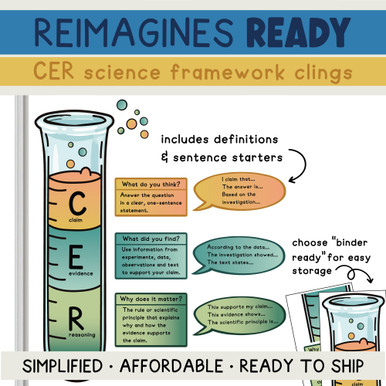 Reimagines Ready CER Science Framework Clings (definitions and sentence starters included)
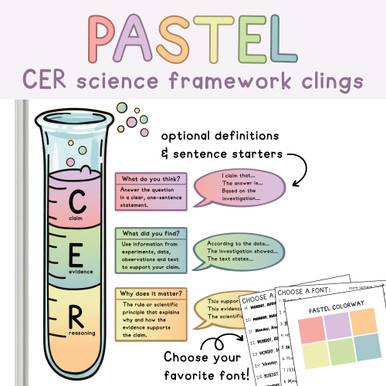 Pastel CER Science Framework Clings
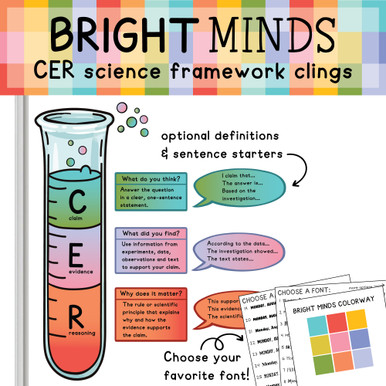 Bright Minds CER Science Framework Clings
All colorways: Blue and Green · Bright Minds · Earth Tones · Happy Camper · Modern Terrazzo · Pastel · Pink and Purple · Rainbow
Using CER in other subjects?
Students learn CER faster when every class uses it. See our guide to CER in math, or shop the CER Math Framework Clings and ELA CER Framework Clings. For lab days, the Scientific Method Clings walk students through the investigation before they write their CER.
FAQ
What does CER stand for in science?
CER stands for claim, evidence, reasoning. The claim answers the question, the evidence is the data that supports it, and the reasoning is the scientific principle that explains why the evidence supports the claim.
What is the difference between evidence and reasoning?
Evidence is what students observed or measured, such as data, observations, or facts from a text. Reasoning is the science concept or rule that explains why that evidence supports the claim.
What grades use CER?
CER is used from upper elementary through high school. Younger students focus on a clear claim and one or two pieces of evidence. Older students use multiple pieces of data and write fuller reasoning with science vocabulary.
Can CER be used outside of science?
Yes. CER works in math, ELA, and social studies too. In ELA, evidence comes from the text. In math, evidence is the work that shows how a problem was solved.
Is the CER anchor chart a sticker?
No. It's a static cling, so it holds to a clean whiteboard without adhesive and comes off with no residue. You can move it, store it, and reuse it year after year. Don't write on the clings, since markers can remove the ink. Write under or next to them instead.
Will it stick to my whiteboard?
Static cling holds best to a clean, dust-free board. Dust, oil, and greasy cleaners interfere with the grip, so wipe your board with vinegar and water first. If a cling loses its grip, rinse the back with water. It was originally designed for non-magnetic whiteboards and also clings to glass, windows, and acrylic.
Can I get custom colors or a custom design?
Yes. Choose from eight colorways with font and text color options, or email elizabeth@reimagines.com for custom designs and color matching.
No printing, cutting or laminating! Just peel, cling and teach.
Put claim, evidence, and reasoning where every student can see it.
Shop CER Science Clings