
The CUBES Math Strategy: Steps, Examples, and How to Use It Well
By Elizabeth Schroer, Founder of Reimagines · November 2026
CUBES is a five-step strategy for solving math word problems: Circle the numbers, Underline the question, Box the key words, Evaluate and plan, and Solve and check. It gives students a place to start when a word problem feels overwhelming.
If your students stare at a word problem and don't know where to begin, or grab every number and add them together, CUBES slows them down and gives them a plan. Below you'll find what each step means, worked examples, a clue word chart, honest tips for avoiding the most common CUBES pitfalls, and ideas for teaching it from second grade through middle school.
What is the CUBES math strategy?
CUBES is an acronym that walks students through a word problem one step at a time. Students mark up the problem, decide what it's asking, choose an operation, and then solve and check. It's most common in grades two through six, and it's a favorite in special education and intervention settings because every step is something students can physically do.
- Circle the numbers
- Underline the question
- Box the key words
- Evaluate and plan
- Solve and check
You'll see a few versions of the E. Some teachers use "Eliminate extra information," and others use "Evaluate," "Explain," or "Evaluate and eliminate." They all ask the same thing: stop and think before you calculate.
The five steps of CUBES
These are the same steps and student questions printed on our CUBES instruction clings.
Circle
Circle the numbers. What does each number represent?
Underline
Underline the question. What are you trying to find?
Box
Box the key words. Put a box around clue words. Clues help you choose the operation.
Evaluate
Evaluate and plan. What do I know? What do I need to find out? Which operation makes sense?
Solve
Solve and check. Show your work. Does my answer make sense? How can I double check?
Read it first. Before anyone picks up a pencil, have students read the whole problem and tell a partner what's happening in the story. CUBES works best as a way to organize thinking about a problem students already understand.
CUBES examples
Here are three examples you can model with your class. Notice how the questions on each step keep students focused on meaning, not just marking up the page.
Grades two and three: two steps
Circle24 (stickers Maya started with), 9 (stickers she gave away), 6 (stickers she bought).
Underline"How many stickers does Maya have now?" We're finding the number she has at the end.
Box"gave" and "bought more." Giving away makes her pile smaller. Buying more makes it bigger.
EvaluateFirst subtract the stickers she gave away, then add the stickers she bought.
Solve24 − 9 = 15. Then 15 + 6 = 21. Maya has 21 stickers. Check: she gave away more than she bought, so ending with fewer than 24 makes sense.
Grades four and five: extra information
Circle26 (students), $320 (trip cost), 48 (boxes sold), $5 (price of each box).
Underline"How much more money do they need?" We're finding the difference between the cost and what they've raised.
Box"each" and "how much more." Each points to equal groups. How much more points to a difference.
EvaluateThe number of students doesn't change the answer, so cross it out. Multiply to find how much they raised, then subtract from the trip cost.
Solve48 × $5 = $240. Then $320 − $240 = $80. They need $80 more. Check: $240 + $80 = $320.
The key word trap
Box"left" usually makes students think subtract. But 7 − 4 = 3, and Ava can't start with fewer crackers than she has now.
EvaluateShe had some, ate 4, and has 7 left. To find the start, put the 4 back.
Solve7 + 4 = 11. Ava started with 11 crackers. Check: 11 − 4 = 7.
Problems like this one are worth teaching on purpose. They show students why asking "Which operation makes sense?" matters more than any single clue word.
Clue words chart
Clue words can point students in the right direction, but they're clues, not rules. Always confirm them with the story.
Addition
in all, total, sum, altogether, combined, more than, increased by
Subtraction
difference, how many more, how much less, fewer, remain, decreased by
Multiplication
each, every, times, twice, groups of, product, per
Division
shared equally, split, each gets, per, quotient, divided into groups
How to make CUBES work
CUBES has critics, and they make fair points. Teachers have noticed that students can circle, underline, and box perfectly and still not understand the problem, and that none of the steps say to read the problem. Others warn that key words are unreliable when they're taught as commands. These habits keep CUBES useful:
- Read and retell first. Students should be able to explain the story in their own words before marking anything.
- Ask what each number means. Circling 24 isn't enough. Students should say "24 is the stickers she started with."
- Treat key words as clues. Teach "Which operation makes sense?" as the real decision, and assign trap problems on purpose.
- Draw it. A quick picture, bar model, or number line during the E step helps students see the problem.
- Always check. "Does my answer make sense?" catches more mistakes than any other step.
- Fade it. As students get stronger, they won't need to mark every step. The goal is the thinking, not the annotations.
How to teach CUBES
- Start with one-step problems. Let students learn the routine before the math gets hard.
- Model it out loud. Solve a problem in front of the class and say your thinking for each letter.
- Use a problem of the day. Post one word problem next to your CUBES chart each morning and solve it together.
- Mark it up on the board. Have students come up and circle, underline, and box right on the whiteboard.
- Partner check. One partner explains their E step while the other listens for whether the operation makes sense.
- Point back during independent work. When students get stuck, point to the next letter instead of giving the answer.
CUBES and other strategies
CUBES is one of several word problem strategies. UPS Check (Understand, Plan, Solve, Check) and Read, Draw, Write are two others you might see. Many teachers start with CUBES because it's concrete, then move toward strategies that ask students to explain their reasoning.
When students are ready to write about how they solved a problem, try claim, evidence, reasoning. Our guide to CER in math shows how. For written responses in other subjects, see the RACES writing strategy.
Keep CUBES on your whiteboard
Paper anchor charts take time to make, and they tear, curl, or get covered up halfway through the year. So we made a CUBES anchor chart that lives right on your whiteboard, next to your problem of the day.
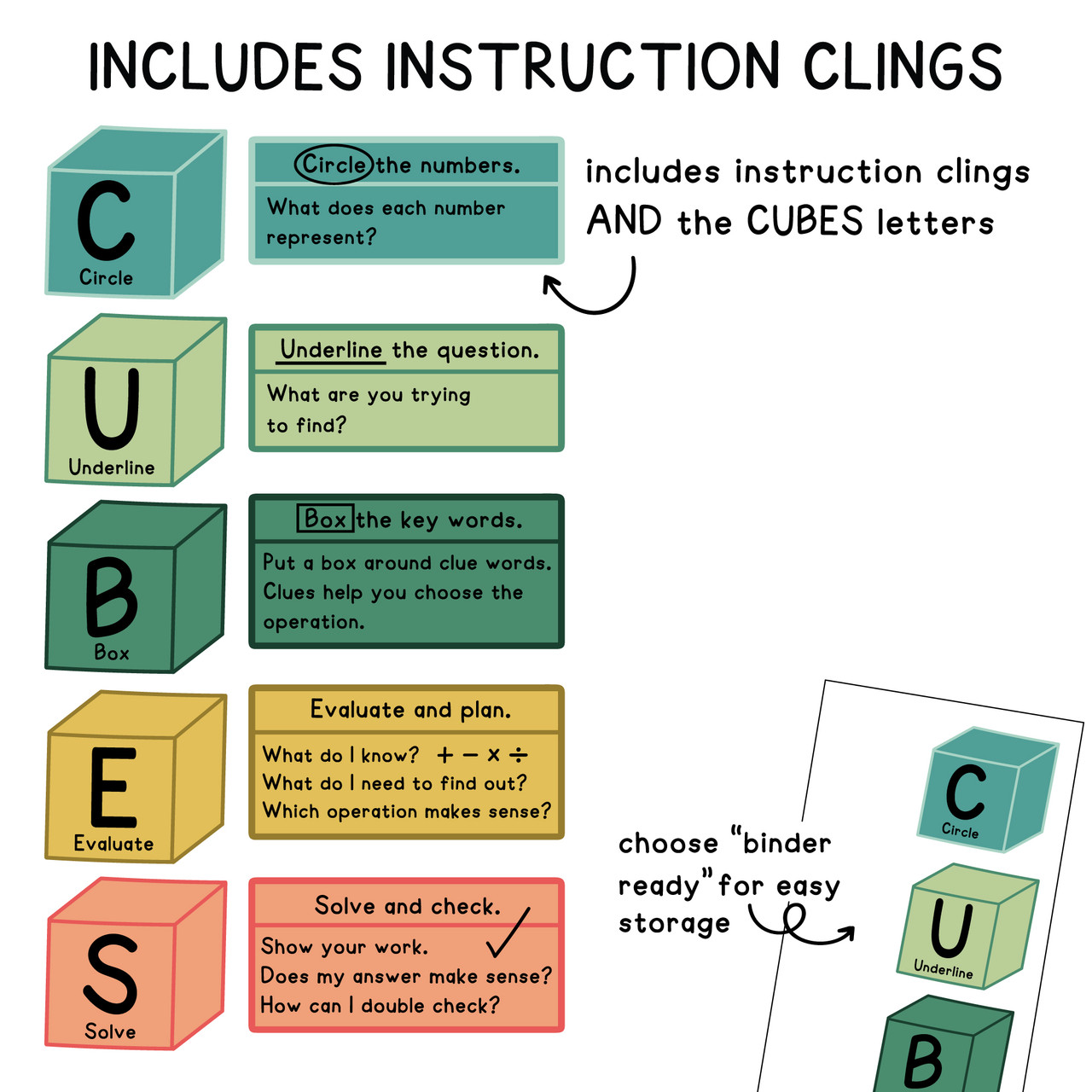
Our CUBES Math Strategy Clings include five 4.5" letter clings, C for Circle, U for Underline, B for Box, E for Evaluate, and S for Solve. Add the five instruction clings with the student questions for each step, and students have everything they need to check their own work.
- Not a sticker. It's a durable, flexible static cling that holds to a clean whiteboard with no adhesive and no residue.
- Works on non-magnetic whiteboards, plus glass, windows, and acrylic.
- Reusable. Leave it up all year, or store it on Binder Ready sheets between units.
- Ready the day it arrives. No designing, printing, laminating, or cutting. Designed and printed in-house by our family and shipped within two business days.
Two ways to order: the Reimagines Ready set comes in one ready-made look with the instruction clings included. Or choose your colorway, font, and text color, and add the instruction clings if you'd like them.
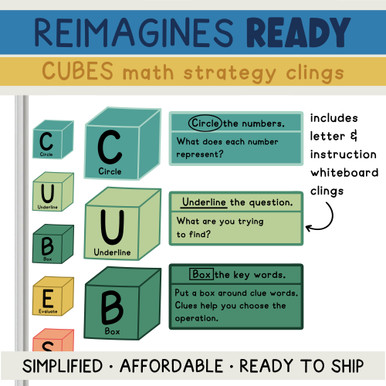 Reimagines Ready CUBES Math Strategy Clings (instructions included)
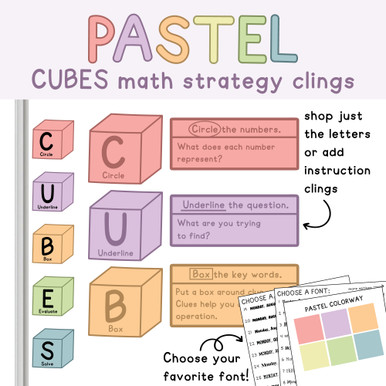 Pastel CUBES Math Strategy Clings
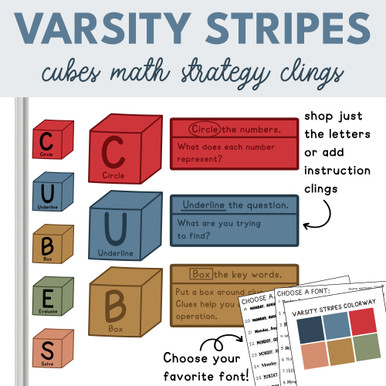 Varsity Stripes CUBES Math Strategy Clings
All colorways: Blue and Green · Bright Minds · Earth Tones · Happy Camper · Modern Terrazzo · Pastel · Pink and Purple · Rainbow · Retro Brights · Tropical Botanical · Varsity Stripes
More teaching guides
See all of our free teaching guides, including CER in math and science, RACES, and CHAMPS.
FAQ
What does CUBES stand for in math?
CUBES stands for Circle the numbers, Underline the question, Box the key words, Evaluate and plan, and Solve and check. Some versions use "Eliminate extra information" for the E.
What grade is the CUBES strategy for?
CUBES is most common in grades two through six, and it's often used in special education and math intervention. Older students can use it for multi-step problems, then move toward strategies that focus on explaining their reasoning.
Is CUBES a good strategy?
It's a helpful starting point when students don't know how to begin a word problem. It works best when students read and retell the problem first, explain what each number means, and treat key words as clues rather than rules.
What does the E stand for in CUBES?
It depends on the version. Common choices are Evaluate, Eliminate extra information, Explain, or Evaluate and eliminate. All of them ask students to stop and plan before they calculate.
Is the CUBES anchor chart a sticker?
No. It's a static cling, so it holds to a clean whiteboard without adhesive and comes off with no residue. Don't write on the clings, since markers can remove the ink. Write your problem of the day next to them instead.
Will it stick to my whiteboard?
Static cling holds best to a clean, dust-free board. Dust, oil, and greasy cleaners interfere with the grip, so wipe your board with vinegar and water first. If a cling loses its grip, rinse the back with water. It was originally designed for non-magnetic whiteboards and also clings to glass, windows, and acrylic.
Can I get custom colors or a custom design?
Yes. Choose from 11 colorways with font and text color options, or email elizabeth@reimagines.com for custom designs and color matching.
No printing, cutting or laminating! Just peel, cling and teach.
Give students a plan for every word problem.
Shop CUBES Clings